

Is a Whole-House Dehumidifier Worth It? A Homeowner’s Guide for SE PA in 2026

Whole-House Dehumidifier | Best Dehumidifier | West Chester, PA

Last Revised: 5/1/2026

If your basement smells musty in July, you’ve spotted mold in a corner you’d rather ignore, or you crank up the AC more than you’d like just to stay comfortable, your home is telling you something. Southeastern PA summers are genuinely humid. And when outdoor humidity gets into your home, it doesn’t just feel uncomfortable…it causes real damage.

A whole-house dehumidifier is the holistic answer to the humidity question. This article will walk you through how to know if you need one, how these systems work, what they cost, and which options Mattioni installs in homes across Chester, Delaware, and Montgomery counties.

After reading this, you’ll have everything you need to make a confident decision.


What is a Whole-House Dehumidifier, and How is it Different from a Portable One?

You’ve probably seen the portable dehumidifiers at hardware stores. They sit in your basement, hum along, and need their water tray emptied every day or two. They work fine for a single room, but they weren’t designed to protect your whole home.

A whole-house dehumidifier is a different category of equipment entirely. These are professional-grade units that either connect directly to your existing HVAC ductwork or operate as standalone high-capacity systems. They run automatically, drain continuously without any tray to empty, and treat the air throughout your entire home.

The key number to understand with dehumidifiers is capacity, measured in pints of moisture removed per day. A typical portable unit removes 30-50 pints per day. The whole-house systems Mattioni installs remove 80 to 130 pints per day. That’s not a small difference.


What a Whole-House Dehumidifier Actually Does for Your Home

Before jumping into whether you need one, it helps to understand what you’re actually getting. A whole-house dehumidifier doesn’t just make your basement feel less damp. It delivers a set of real, everyday benefits that most homeowners appreciate.


1. Your family breathes better.

High humidity is a direct driver of mold, dust mites, and airborne allergens. Keeping your home below 55% relative humidity significantly reduces the conditions those things need to grow and spread. If anyone in your home has asthma, allergies, or recurring sinus issues, you’ll notice the difference.


2. Your home stays in better shape.

Wood floors, drywall, framing, furniture, and stored belongings all absorb moisture over time. Cupped floors, peeling paint, warped doors, and corroding metal are all symptoms of a home that’s been too humid for too long. A dehumidifier stops that damage before it starts.


3. Your AC works less and lasts longer.

Air conditioners remove some moisture as a side effect of cooling, but they shut off once the thermostat target is reached, even if the air is still heavy. A whole-house dehumidifier picks up where your AC leaves off. With humidity managed, most homeowners find they can raise their thermostat 2-3 degrees and feel just as comfortable, which means the AC runs less, costs less to operate, and experiences less wear and tear.


4. Your home just feels more comfortable.

There’s a comfort that comes from air that’s actually dry during the peak of sticky, humid weather in July and August.


Signs Your Home Needs a Whole-House Dehumidifier

Your home will usually tell you before you think to ask. Here’s what to look for:


  • A persistent musty or earthy smell in the basement, laundry area, or crawl space
  • Condensation on windows, cold pipes, or basement walls, especially on warm summer mornings
  • Visible mold or dark spots on drywall, wood framing, ceiling tiles, or stored belongings
  • Wood floors that cup, buckle, or feel soft underfoot
  • Humidity readings above 60% on a hygrometer (a simple measurement tool you can pick up for under $15)
  • Family members with worsening allergy or asthma symptoms, particularly at home
  • A crawl space that feels damp, or insulation that looks discolored or failing

If more than two of these describe your home right now, you’re past the point where a portable unit is going to solve the problem. Humidity above 60% is where mold begins to grow within 24 to 48 hours on organic surfaces like wood, drywall, and cardboard.


What Humidity Levels Should Your Home Actually Be At?

Here’s a practical guide to target levels by season for homes in Southeastern PA. These are the numbers a whole-house dehumidifier is designed to automatically maintain.

Season Target Relative Humidity Why it matters
Spring (Mar–May)
40–50%
Rising outdoor humidity starts affecting indoor air
Summer (Jun–Sep)
45–55%
Peak humidity season in SE Pennsylvania
Fall (Oct–Nov)
35–45%
Ease back gradually as temps drop
Winter (Dec–Feb)
30–40%
Too dry causes its own problems below 30%
Danger zone
Above 60%
Mold can begin growing within 24–48 hours

The sweet spot for year-round comfort in this region is 45-55% relative humidity in summer, easing down to 30-40% in winter. Below 30%, air gets too dry and causes its own problems: static electricity, cracked wood, dry skin and sinuses. Above 60% and you’re in mold territory

A properly sized whole-house dehumidifier holds your home in that safe middle zone without you thinking about it.


The Aprilaire E-series: Good, Better, and Best Options for SE PA Homes

Mattioni installs the Aprilaire E-series whole-house dehumidifiers. Aprilaire is the leading manufacturer in the whole-house dehumidification category, and their E-series units are the first whole-house dehumidifiers to earn ENERGY STAR Most Efficient certification. They’re built in the USA with corrosion-resistant aluminum coils, include a removable washable filter, and come with a 5-year warranty.

All three models can be ducted directly into your existing HVAC system for whole-home coverage, or installed as a standalone unit if you don’t have pre-existing ductwork. The right setup depends on your home’s layout and where the moisture problem is concentrated.

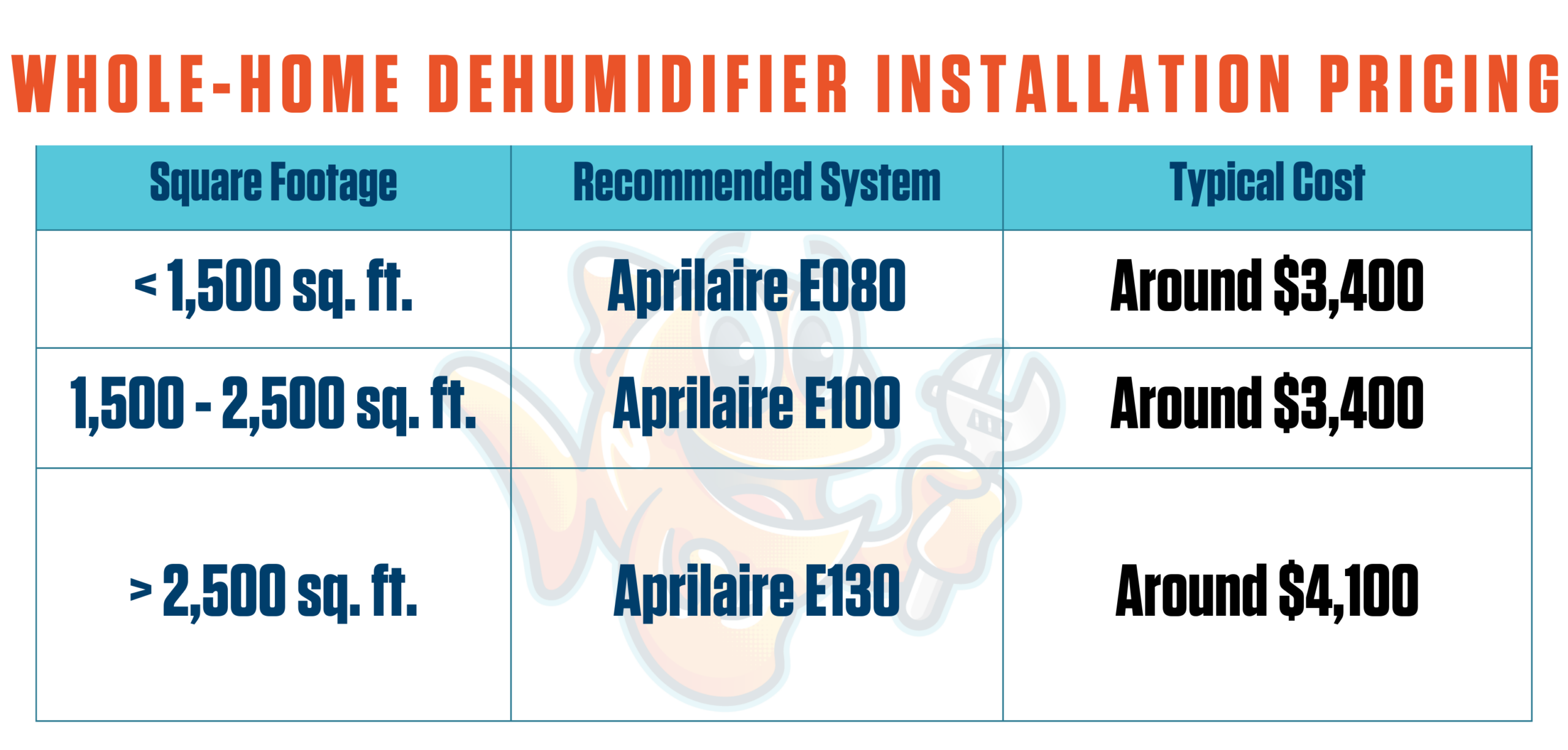
The square footage numbers below reflect real-world home applications during peak summer humidity, as recommended by Mattioni. A Mattioni technician will evaluate your home’s actual moisture load, layout, and installation type in order to recommend the system best suited for you, rather than looking just at square footage.

Here’s how the three models compare:

Good
E080
Better
E100
Best
E130
Capacity 80 pints/day
(10 gallons)
100 pints/day
(12.5 gallons)
130 pints/day
(16 gallons)
Mattioni’s Recommended Coverage* Up to 1,500 sq ft 1,500 to 2,500 sq ft Over 2,500 sq ft
Installation Standalone or ducted Standalone or ducted
Multiple variants available
Standalone or ducted
High-capacity freestanding
Best for Basements, crawl spaces, targeted moisture problems Whole-home coverage, basement + crawl space Large homes, high-moisture environments, recurring problems
ENERGY STAR All three models — Most Efficient certified
Warranty 5 years — all models. Built in the USA with corrosion-resistant aluminum coils.

*A Mattioni technician will size the right unit based on your home's actual moisture load and layout.

E080: the good option for smaller homes and targeted spaces

The E080 removes 80 pints (10 gallons) of moisture per day. It can be installed as a standalone unit (if you don’t have ductwork) in a basement or crawl space, or ducted into existing ductwork. It has a 10-inch duct collar for either setup. It’s our most common recommendation for colonial and rancher-style homes under 1,500 square feet throughout Chester County. The built-in digital control mounts on the top or front of the unit, making it easy to set and forget.


E100: the better option for mid-size to larger homes

The E100 steps up to 100 pints (12.5 gallons) per day. It’s available in several variants to suit different installation needs: a standard plug-in model, a version with casters for standalone flexibility, and a hardwired model for permanent installation. It can also be programmed to circulate air throughout the space to even out humidity levels and temperatures, which makes it a strong choice for whole-home ducted installations. If your home is between 1,500 and 2,500 square feet or has a large basement and crawl space to protect, this is typically the model we recommend.


E130: the best option for larger or persistently humid homes

The E130 is the top-capacity unit at 130 pints (16 gallons) per day and is typically a good fit for homes over 2,500 square feet. It works as a high-capacity freestanding unit or in a ducted setup. It’s designed for high-moisture environments: larger homes, finished basements with significant square footage, homes near watersheds or low-lying areas, or any property where humidity has been a recurring problem even after prior dehumidification attempts. If your tech recommends the E130, there’s a real moisture load in your home that warrants the capacity.

All three units feature automatic operation, continuous drainage (no trays to empty), and set-it-and-forget-it humidity control. Once the target is set, the unit runs only when needed.
Dehumidifier Cost | Best Dehumidifier | Indoor Air Quality | Best HVAC Company, Collegeville, PA


How Long Does a Whole-House Dehumidifier Last?

A well-maintained whole-house dehumidifier typically lasts 8-12 years. The Aprilaire E-series units are backed by a 5-year warranty and built with corrosion-resistant aluminum coils designed for long-term performance in humid environments. Maintenance is minimal: clean the onboard filter once a year and ensure the drain line stays clear.

If the unit is installed during an HVAC service visit, your Mattioni technician can check it annually as part of a regular maintenance call.


 

Frequently Asked Questions

A well-maintained whole-house dehumidifier typically lasts 8–12 years. The Aprilaire E-series units are backed by a 5-year warranty and built with corrosion-resistant aluminum coils designed for long-term performance in humid environments. Maintenance is minimal: clean the onboard filter once a year and ensure the drain line stays clear. If the unit is installed during an HVAC service visit, your Mattioni technician can check it annually as part of a regular maintenance call.
For summer in Southeastern Pennsylvania, aim for 45–55% relative humidity. That keeps you comfortable, protects your home's structure and belongings, and stays well below the 60% threshold where mold begins to grow. Your unit will maintain that target automatically once it's set — no manual adjustments needed as conditions change.

Yes. A ducted whole-house dehumidifier can be integrated with most central HVAC systems. The unit connects to your existing ductwork, and a wall-mounted humidistat controls when it runs. If ductwork isn't accessible, a standalone unit can also be installed in a basement, crawl space, or equipment room without modifying your HVAC at all. Your Mattioni technician will walk you through both options and recommend the right approach for your home.

For most homes in Chester, Delaware, and Montgomery counties, yes. This region's summer humidity is high enough that a whole-house dehumidifier pays for itself through avoided damage to wood floors, drywall, stored belongings, and HVAC equipment that works harder in a humid home. Once humidity is managed, most homeowners find they can raise their thermostat 2–3 degrees and feel just as comfortable, which reduces AC runtime and extends its lifespan. Beyond the financial side, breathing air that isn't thick with moisture and mold spores is simply better for your family's health.

Capacity is measured in pints of moisture removed per day. The Aprilaire E080 covers up to 1,500 sq ft, the E100 up to 2,500 sq ft, and the E130 covers any home over 2,500 sq ft. Those are Mattioni's ratings under standard conditions. In practice, the right unit depends on your home's actual moisture load, layout, and whether you're installing standalone or ducted. A Mattioni technician can assess your home and give you a specific recommendation before any purchase.

So, Is a Whole-House Dehumidifier Worth It?

For most homes in Chester, Delaware, and Montgomery counties: yes. Not because it’s a nice upgrade, but because SE Pennsylvania summers are genuinely hard on homes. Humidity above 60% damages wood, feeds mold, strains your AC, and makes air feel heavier than it needs to. A properly sized whole-house dehumidifier addresses all of that with one permanent solution.

The Aprilaire E-series gives you three well-built options at different capacity levels, all backed by a 5-year warranty, all ENERGY STAR Most Efficient certified, and all able to be installed directly into your ductwork. You’ll be able to match your home’s needs with the right unit, and that’s exactly what a Mattioni technician will assess before recommending anything.

If you’ve been tolerating a musty basement, watching your floors change shape, or running a portable dehumidifier that never quite keeps up, this is the fix. And if you’re not sure whether you need one at all, that’s exactly the kind of question we’re happy to answer.

Ready to find out which system is right for your home? We’re here when you need us. Call us at (610) 400-8510 or book your appointment online. We offer same-day service across Chester, Delaware, and Montgomery counties.

About the Author

Jarod Meyer

Jarod Meyer is the Content Manager of Mattioni Plumbing, Heating & Cooling’s Learning Center. With a background in B2C marketing and digital journalism, he has researched and written more than 270 articles covering plumbing and HVAC systems while collaborating with Mattioni’s licensed technicians to ensure the information shared reflects real-world service experience. Read More