
Quick Answers: Frozen Pipes
How do I know if my pipes are frozen?
The clearest signs are little or no water coming from a faucet when others in the house still work, frost or bulging on a visible pipe, banging or whistling noises when you run water, and unusual odors from a drain (trapped by the ice instead of flowing away).
At what temperature do pipes actually freeze?
As a rule of thumb, uninsulated pipes are at meaningful risk after roughly 6 hours below 20°F, or about 12 hours between 20-32°F. Pipes in exterior walls, attics, crawl spaces, and garages freeze first because they're least protected from the house's heat.
Can I thaw a frozen pipe myself?
Often yes, if you can see and reach the frozen section. Never use an open flame. A hair dryer, heating pad, or towels soaked in hot water applied starting from the faucet end of the frozen section is the safe approach. If you can't locate or reach it, stop and call a plumber.
Is a frozen pipe about to burst?
Not necessarily, but it's a real risk — ice expanding inside a pipe builds pressure that can crack it, and that crack often doesn't leak until the ice starts to melt. If you hear a pop, see water, or notice a bulge, shut off your main water valve immediately and call a plumber.
Last Revised: 10/2/2026
You turn on the faucet and barely anything comes out. Or nothing at all. If it's been a genuinely cold night in Chester County, your first thought is probably right: a pipe somewhere in your house has frozen. The good news is that catching it early — before it bursts — is usually the difference between a minor inconvenience and a very expensive one.
Here's how to actually confirm it, what to safely do about it yourself, and exactly when to stop and call us instead.
How to Tell If Your Pipes Are Frozen
1. Little or No Water From One Fixture (While Others Work Fine)
This is the single most reliable sign. If one faucet is reduced to a trickle or nothing at all while others in the house run normally, the pipe feeding that fixture is the one that's frozen — not your whole water supply. That narrows down where the problem is before anyone even looks at a pipe.
2. Frost or a Visible Bulge on a Pipe
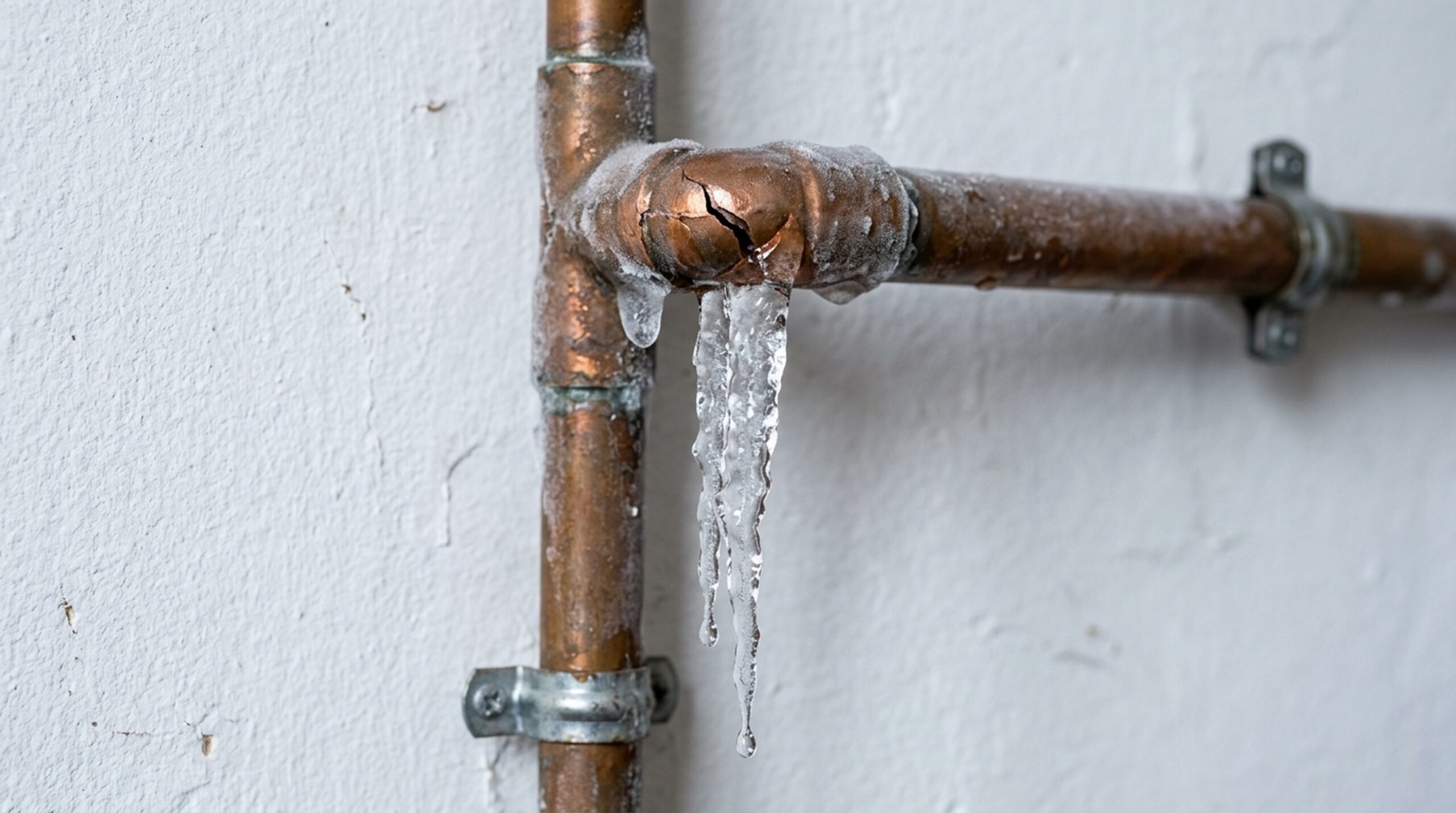
Check any exposed pipes you can safely see — under sinks, in the basement, or in a crawl space. Frost on the outside of a pipe is a direct, visible sign of ice inside it. A bulge or warped section is a more urgent sign: that's the pipe under pressure from the ice, and it's at real risk of cracking.
3. Banging, Clanking, or Whistling When You Run Water
Unusual noises when you turn on a faucet — banging, clanking, or a whistling sound — often mean water is trying to move past a partial ice blockage. Don't ignore this one just because water is still coming through; partial freezing can progress to a full blockage (and a burst) within hours.
4. Bad Smells From a Drain
If a drain starts smelling off, it may be because ice is trapping waste and odors that would normally flow away. This is a less obvious sign than the others, but worth connecting to the others if your home has had a cold night and odors show up alongside reduced water flow elsewhere.
As a rule of thumb: uninsulated pipes are at real risk after about 6 hours below 20°F, or roughly 12 hours between 20-32°F. Pipes running through exterior walls, attics, crawl spaces, and garages are almost always the first to go, since they get the least benefit from your home's heated interior.
How to Safely Thaw a Frozen Pipe
If you've found the frozen section and can reach it, here's the safe process:
- Open the faucet the frozen pipe feeds. Keep it on a slow, steady trickle while you work — this relieves pressure as the ice melts and gives you an immediate sign of progress.
- Start applying heat at the end closest to the faucet, then move toward the blockage. Thawing from the middle or the far end first traps melting water (and steam) behind ice with nowhere to go.
- Use a hair dryer, heating pad, or towels soaked in hot water. Wrap or hold the heat source directly against the pipe and keep it moving along the frozen section.
- Keep going until full water pressure returns, then check other faucets fed by the same line for the same issue.
Never use: a blowtorch, propane heater, or other open flame near a pipe — this is a serious fire and pipe-damage risk, especially near wood framing. Also avoid pouring boiling water directly on a pipe; the sudden temperature change can crack it. If you can't find or reach the frozen section, or you see a bulge, crack, or any water escaping, stop and call a plumber rather than continuing to apply heat.
What If the Pipe Has Already Burst?
A frozen pipe doesn't always leak while it's frozen — the real danger often shows up as it thaws, once meltwater starts moving through a section that cracked under pressure. If you hear a pop, see water pooling, or notice a pipe has visibly split, shut off your main water valve immediately and call us. Our guide on what to do when your pipes burst walks through the emergency steps in more detail, and how to find and use your main water shutoff valve is worth bookmarking now, before you need it in a hurry.
What This Actually Costs (If You Wait)
We'd rather you know this upfront. According to the Insurance Information Institute, the average U.S. homeowner's insurance claim for water damage and freezing exceeded $12,500 between 2017 and 2021 — and roughly 1 in 60 insured homes files a water-damage claim in any given year. Catching a frozen pipe early, before it bursts, is almost always the cheaper outcome by a wide margin.
The best version of this problem is the one you never have — our 8-step winter plumbing prep checklist covers pipe insulation, outdoor faucet blow-outs, and the other prevention steps that stop this from happening in the first place.
Related reading:
- The Homeowner's Winter Plumbing Prep Checklist (8 Steps)
- What to Do When Your Pipes Burst
- How Do I Shut Off My Main Water Line Valve?
- Why Is My Water Pressure Low?
Don't Wait Out a Frozen Pipe — Call Mattioni
Here's the plan if you suspect a frozen pipe tonight:
- Confirm it. Reduced water at one fixture, frost, banging, or bad odors after a cold night — any of these mean it's worth checking.
- If you can reach it safely, thaw it carefully using the steps above. If you can't, or you see any sign it's already cracked, stop.
- Call us. We'll get a technician out to locate, thaw, or repair the line properly — before a small ice blockage turns into a burst pipe and a much bigger bill.
The Mattioni family has helped Chester County homeowners through tough Pennsylvania winters for over 75 years. Schedule emergency plumbing service online, or give us a call — we're here for you, any time of year.