

Last Revised: 11/21/25
Why does one water heater cost more than another, even if they look the same size? And how do you know which one will actually save you money on energy bills?
If you’re asking yourself these questions, you’re on the right track to finding a water heater that fits your needs – and your budget. And the answer revolves around one efficiency rating: Uniform Energy Factor (UEF).
At Mattioni, we’ve been helping homeowners choose the right water heater for over 75 years. Our trusted team is known for honest advice and five-star service that puts your home’s comfort first.
In this article, we’ll explain what UEF means, why it matters to your home’s energy use, and how best to use it when choosing a water heater. You’ll walk away with a clear understanding of how to read and apply UEF ratings to make a smart, cost-effective choice for your home.
Let’s start with the basics.
What Does UEF Mean?
UEF stands for Uniform Energy Factor. It’s a standardized rating that measures how efficiently a water heater converts energy into hot water – and how much hot water it can deliver in a typical day.
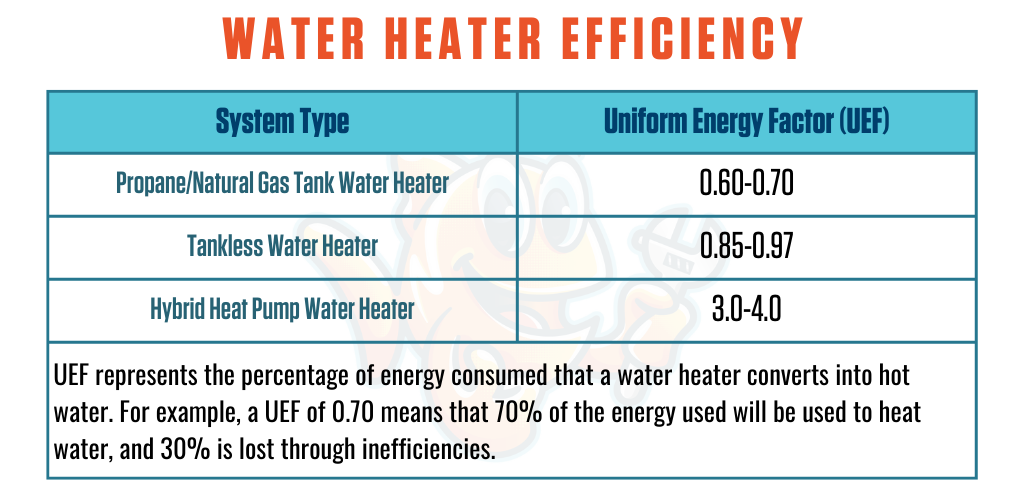
Think of UEF like a miles-per-gallon rating, but for water heaters. The higher the number, the more efficient the unit it. A UEF of 0.90, for example, means 90% of the energy consumed is used to heat water, while 10% is lost as waste (usually in the form of heat that escapes from the tank or during the heating process).
The US Dept. of Energy (DOE) rolled out the UEF system to give you a clearer, apples-to-apples method of comparing different water heaters. It’s required to be included on all new units sold in the US.
How UEF Impacts Your Energy Costs
UEF isn’t just a technical spec – it directly affects your monthly utility bills. A higher UEF means less wasted energy, which can translate into noticeable savings, especially in homes with high hot water usage.
Let’s say your old water heater has a UEF of 0.58 and you upgrade to a new model with a UEF of 0.85. Over the course of a year, that efficiency gain could save you hundreds of dollars, depending on your water usage habits and energy costs in your area.
For those who experience cold winters and high hot water demand, choosing a water heater with a better UEF can help you stay comfortable without driving up energy bills.
What Is a “Good” UEF Rating?
In general, a higher UEF is better – but how high you’re able to achieve depends most directly on the type of water heater.
- Gas and propane tank water heaters typically have UEF ratings from 0.60 to 0.70
- Tankless water heaters typically have UEF ratings from 0.85 to 0.97
- Hybrid heat pump water heaters have the most superior energy efficiency, with UEF ratings from 3.0 to 4.0
If you haven’t replaced your water heater in over 10 years, upgrading to a unit with a UEF above 0.80 can make a sizeable dent in your energy bills.
At Mattioni, we help you balance efficiency with your budget. A super-high UEF might not always be worth the extra upfront cost, depending on your usage. This is where expert advice makes a big difference.
What is First Hour Rating (FHR) on a Water Heater?
While UEF tells you how efficiently a water heater uses energy, FHR (First Hour Rating) tells you how much hot water it can deliver when demand is high – like during the busy morning rush or after multiple showers have already been taken.
FHR measures the total number of gallons of hot water a tank-style water heater can supply in the first hour of use, starting with a full tank. It factors in both the tank’s storage capacity and its recovery rate, or how quickly it can heat new cold water entering the tank.
For example, a 50-gallon gas water heater might have an FHR of 80 gallons, meaning it can provide 80 gallons of hot water in the first hour before starting to run behind on recovery. That could be plenty for your family, or it may fall short during peak usage times.
The best way to determine a FHR that fits your home? Book a consultation with an expert plumber and talk about things like your household’s showers, laundry, and dishwasher.
How to Use UEF When Choosing a Water Heater
It’s your best tool for comparing energy efficiency and long-term value. When you’re shopping for a new water heater, UEF helps you:
- Predict energy costs more accurately
- Choose a system that matches your family’s needs
- Compare different models and fuel types side-by-side
Every manufacturer is required to include UEF on the label of their units, giving you a level playing field when deciding on a new system.
Are you still unsure how UEF fits into your choice? That’s exactly what our team at Mattioni is here to walk you through.
Trust the Experts to Help You Choose the Right System
Choosing a new water heater isn’t just about picking the most efficient model on paper – it’s about finding the right system for your home, lifestyle, and budget.
At Mattioni, we’ve been helping homeowners make decisions like these for over 75 years. We’ve seen the evolution of water heater efficiency, and we know how to cut through the confusion and give you straightforward advice you can trust.
Ready to take the next step to lower energy bills? Schedule your appointment with the pros at Mattioni or give our friendly staff a call at (610) 400-8510 to get started, because your home deserves the most efficient, reliable water heater possible – and we’ll help you find it.