
Quick answers: Audubon, PA water quality
Is Audubon, PA's water safe to drink? +
Pennsylvania American Water, which now runs Audubon's public water, reports that it has met Pennsylvania's drinking water standards for PFAS since August 2025. Federal PFAS limits are stricter and still a few years away, so if you'd like to know exactly what's reaching your faucet, a home water test is the most reliable way to find out.
Does this apply to my home? +
It applies if your water comes from Pennsylvania American Water's Audubon system, which serves the Audubon section of Lower Providence Township, including Shannondell and Valley Forge Crossing. Not every 19403 address is on this system. If you're not sure, Pennsylvania American Water can confirm it with your address.
Does Audubon's water still have PFAS? +
The three wells that tested above state limits were shut off in 2025. Low levels may still be present in the rest of the supply, and the only way to know what's at your tap is to test it.
Where does Audubon's water come from now? +
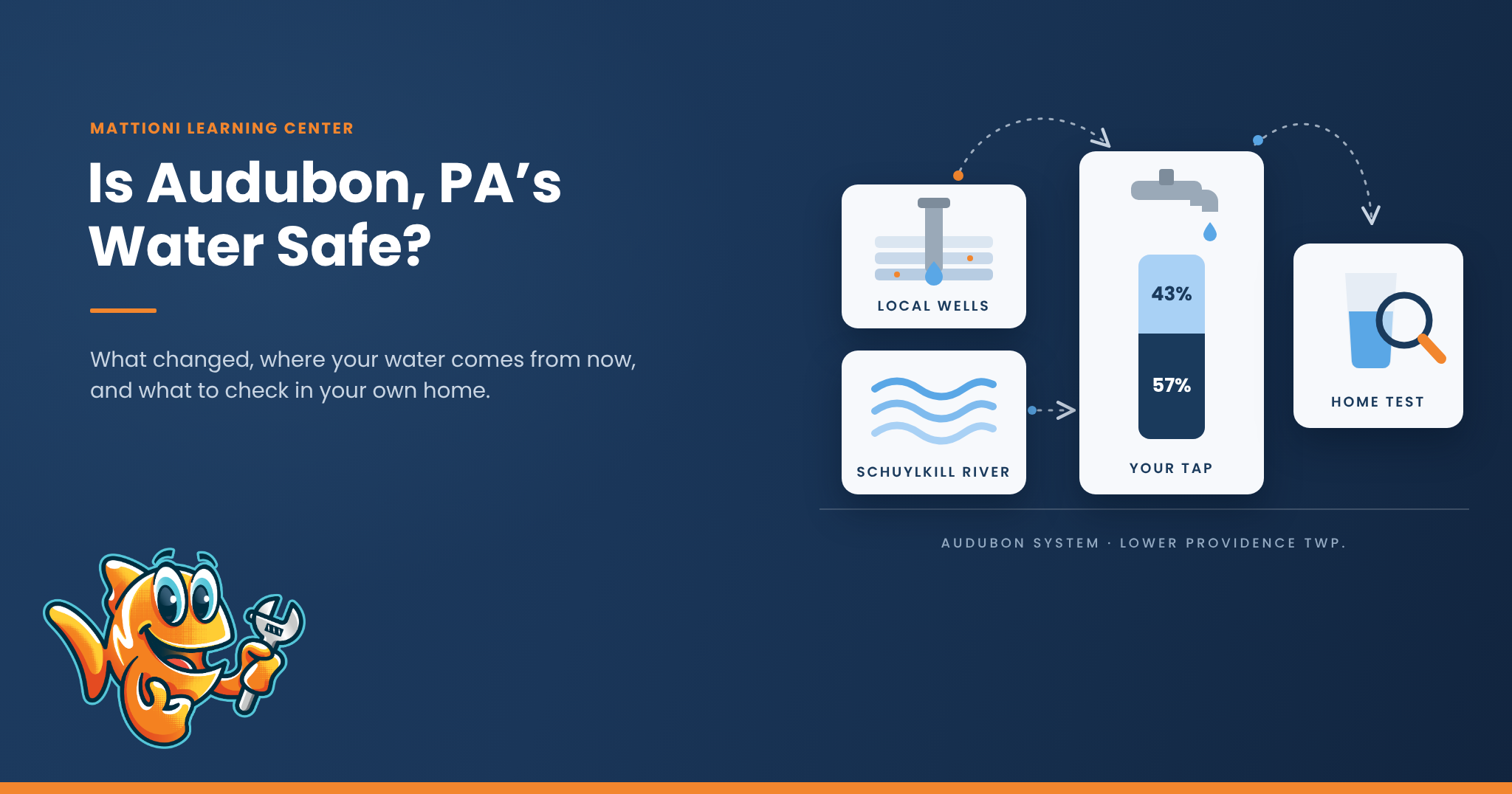
In 2025, about 57% came from local groundwater wells and about 43% from Pennsylvania American Water's Norristown treatment plant on the Schuylkill River.
Is Audubon's water hard? +
Water from the Norristown plant averaged about 8.7 grains per gallon in 2025, which counts as hard. Hardness from Audubon's local wells isn't published, so your home's number could be higher or lower. A quick water test will tell you where you stand.
Why am I seeing rust-colored stains? +
Audubon's 2025 water report showed iron levels slightly above EPA's guideline for taste and appearance. It isn't a health concern, but it can stain sinks, tubs and laundry. A professional visit can confirm whether iron is the cause in your home.
Key Contributor: John Meiklejohn, Mattioni Water Conditioning Specialist
Last Revised: 11/6/26
Since August 2025, the public water serving the Audubon section of Lower Providence Township has met Pennsylvania’s PFAS (“forever chemicals”) standards, according to Pennsylvania American Water.
That followed two years of problems under the former Audubon Water Company and a change of ownership to Pennsylvania American Water in May 2025.
This guide is built to help you answer two questions quickly: does this apply to my home, and if so, what does it mean for my street and my plumbing? It draws on the 2025 water quality report, state and federal rules, and Mattioni’s 75+ years of experience serving Montgomery and Chester County homes.
What’s Ahead
- Does this apply to your home?
- What it means for your specific home
- Audubon water timeline
- What the 2025 PFAS letters meant
- Audubon’s 2025 water report
- Chlorine vs. chloramine taste
- PFAS, hardness, iron and lead
- On a private well?
Does This Article Apply to Your Home?
The Audubon water system doesn’t serve all of Lower Providence. Some homes with an Audubon, Eagleville, Trooper or 19403 address may get their water from a different system.
Three questions tell you whether this article applies to your home
↓ No
↓ Yes
What It Means for Your Specific Home and Street
Even if they’re on the same system, two Audubon homes can have noticeably different water.
| What varies | Why it can differ for your home | How to find out |
|---|---|---|
| Which source reaches your street | Audubon blends local well water with Norristown river water. Where your home sits can affect the mix, and with it the hardness and taste. | A home water test shows what your tap actually delivers. |
| Your home's age and plumbing | Lead usually comes from older pipes, solder or brass fixtures inside a home, not the water main. Homes built before the late 1980s are more likely to have them. | A lead test at your faucet, plus the utility's service line map. |
| Scale on fixtures and your water heater | Hardness varies by source, and well hardness isn't published. | A hardness test gives your home's number. |
| Rust-colored stains | Iron and manganese come mainly from groundwater and can build up in older lines. | A professional visit can pinpoint the cause. |
| Special health needs | Chloramines need removing for dialysis and aquariums. Sodium in Norristown water (35.9 ppm) is above the 20 ppm level the report flags for sodium-restricted diets. | Ask your doctor; a water test can confirm levels at your tap. |
If any of this sounds familiar, a home water test or a visit from a Mattioni technician is the simplest way to get answers about your own home rather than the neighborhood average.
Is Audubon, PA’s Water Safe to Drink?
By today’s PA standards, yes. Since August 2025, the Audubon water system has met the state’s limits for PFAS and its other drinking water standards, according to Pennsylvania American Water.
Still, “meeting the standards” and “knowing exactly what’s in your glass” aren’t quite the same thing. The water company tests water as it leaves its wells and treatment plants, not at your kitchen sink. Your home’s pipes, its age and where it sits in the system all play a part. That’s why a home water test is the most dependable way to get answers about your own water.
Audubon Water Timeline: 2023 to Today
For decades, a small private company, Audubon Water Company, supplied this part of Lower Providence from local wells. Here’s how the system got to where it is today.
- January 2023 Pennsylvania sets its first PFAS limits for drinking water: 14 ppt for PFOA and 18 ppt for PFOS.
- May 2023 Audubon Water Company issues a water conservation notice.
- September 2023 Pennsylvania American Water agrees to buy the system.
- 2024 Public water systems statewide complete a year of quarterly PFAS testing under the new rules.
- December 2024 Sampling finds PFAS as high as 57 ppt at one Audubon entry point (WHYY).
- January 2025 State regulators approve the sale.
- March 2025 Audubon is listed among Philadelphia-area systems out of compliance with state PFAS limits.
- May 28, 2025 Pennsylvania American Water takes ownership.
- July–August 2025 Customers receive PFAS notices (mailed July 7 and August 20) about results above state limits.
- By August 21, 2025 Pennsylvania American Water announces that a new connection to its Norristown system is in service, the three wells over state limits are shut off, five major leaks are repaired and the conservation notice is lifted. The utility reports the system now meets state PFAS standards (PA American Water).
- June 2026 One-year update: about $21.5 million invested, including more than 165 leak detectors and 2,000+ new meters (PA American Water).
What Did the 2025 PFAS Letters Mean?
If you received a PFAS notice in summer 2025, it was a required public notice. Results in June and July 2025 showed PFOA and PFOS above PA’s legal limits at some well entry points.
Those wells were taken out of service by August 2025, and Pennsylvania American Water reported the issue resolved in its 2025 water quality report. If you’d like peace of mind about what’s in your water today, a home water test that includes PFAS from an accredited lab gives you answers specific to your tap.
Where Does Audubon’s Water Come From Now?
Audubon’s water now comes from two places, and many homes likely get a mix of both. Here’s how that mix split in 2025, according to Pennsylvania American Water’s 2025 water quality report for Audubon:
- About 57% comes from local groundwater wells, the system’s original source.
- About 43% is treated surface water piped in from the company’s Norristown plant, which draws from the Schuylkill River.
Audubon's tap water is a blend of local wells and Norristown river water
↓
Source: Pennsylvania American Water, 2025 Water Quality Report (Audubon)
Why Does My Water Taste or Smell Like Chlorine?
Both water sources are disinfected so bacteria can’t grow in the pipes on the way to your home, but they use slightly different methods. Well water is treated with chlorine, while water from the Norristown plant is treated with chloramines, a longer-lasting blend of chlorine and ammonia.
Both are safe and approved for drinking water. Some people notice a pool-like taste or smell from time to time. If you’re looking for a lasting solution, a carbon filter designed for chloramines can help with taste and odor.
PFAS in Audubon Today
Audubon’s water has met Pennsylvania’s PFAS limits (14 ppt for PFOA and 18 ppt for PFOS) since August 2025. The federal limit is stricter, 4 ppt for each, and utilities have until 2029 to meet it (or 2031, if EPA finalizes a proposed extension). Pennsylvania American Water hasn’t yet published PFAS results for Audubon’s blended water since the fix.
If you’d like to know where your own tap stands, a lab test that includes PFAS will tell you. For how PFAS get into water, how to read your results and which filters actually reduce them, see our complete guide to PFAS in drinking water.
Is Audubon’s Water Hard?
Part of it is. Water from the Norristown plant averaged about 8.7 grains per gallon in 2025, and anything above 7 is considered hard. Hardness from Audubon’s wells isn’t published, so your home’s number depends on your mix.
Because Audubon’s hardness varies by source, a simple hardness test is the best way to learn your home’s actual number before deciding whether a water softener makes sense. Curious about cost? Here’s our guide to what a water softener costs.
Why Am I Seeing Rust Stains?
Iron in Audubon’s water averaged slightly above EPA’s guideline for taste and appearance in 2025, and manganese sometimes ran above its guideline. Neither is a health concern at these levels, but both can leave reddish-brown or dark stains on sinks, tubs and laundry.
If you’re seeing stains, a visit from a pro can confirm whether iron is the cause and whether a filter would help.
Lead Usually Comes From Plumbing, Not the Water Main
Audubon’s water passed its most recent lead testing: 2025 samples from 20 homes were all below the federal action level. Lead, though, usually enters water through a home’s own pipes, solder or older brass fixtures, so two neighbors can have very different results.
If your home was built before the late 1980s, a water quality test is a reassuring step. You can also check your service line material on PA American Water’s service line map.
On a Private Well Near Audubon? Consider a PFAS Test
Everything above applies to homes on public water. If your home has its own well, your water isn’t tested by a utility, so testing is on you.
A Penn State study of 167 private wells across Pennsylvania found PFAS in about 65% of them, and about 18% were above at least one health-based limits. The highest levels turned up in southeastern Pennsylvania. A standard well test usually doesn’t include PFAS, so it’s worth asking for it by name.
Which Water Treatment Fits Which Problem?
No single system fixes every water concern; the right fit depends on what your test shows. A softener handles hardness, carbon filtration handles chlorine taste, and point-of-use filtration targets PFAS.
Most homes on public water pair well with a City Water Conditioning Package, and homes on private wells with a Well Water Conditioning Package. For a closer look at your options, see Which Water Filter Is Right for Me?
Better Water Starts With Knowing What’s In It
Audubon’s water has come a long way since 2024, and that’s good news for everyone in the neighborhood. A community water report, though, can only tell you so much. What matters most is what’s coming out of your faucet.
Here’s how to get there:
- Notice the signs. Spots, stains, a chlorine taste or simple curiosity about PFAS are all good reasons to look closer.
- Schedule a water test with Mattioni. Our team, based right on Trooper Road, will test your water and explain the results in plain language.
- Choose what fits your home. If anything needs attention, we’ll recommend only what your water actually calls for.
Instead of wondering about every glass you pour, you’ll know exactly what’s in your water and feel confident it’s right for your family. Call us at (610) 400-8510 or book online.
Reading Continued: