
Quick answers: PFAS in drinking water
What are PFAS and how do I remove them from my water?
PFAS are man-made "forever chemicals" that barely break down in the environment or the body. A reverse osmosis (RO) or activated carbon filter certified to NSF/ANSI 58 or 53 for PFAS reduction can significantly lower PFAS at your kitchen tap. Reverse osmosis is the most effective option.
Are there PFAS in Chester County water?
There's a good chance PFAS are present at some level, whether you're on public water or a private well. PFAS have been detected in water systems across Chester and Montgomery counties, and several local providers are building PFAS treatment. A water quality report or an accredited lab test will tell you your levels.
What is the legal limit for PFAS in drinking water?
The EPA limit for PFOA and PFOS is 4 parts per trillion each. Public water systems must comply by 2029, and the EPA has proposed allowing extensions to 2031. Pennsylvania's current limits are 14 ppt for PFOA and 18 ppt for PFOS.
Does a water softener remove PFAS?
No. A water softener swaps out hardness minerals like calcium and magnesium, but it does nothing for PFAS. To reduce PFAS, you need a certified reverse osmosis system or activated carbon filter.
Key Contributor: John Meiklejohn, Mattioni Water Conditioning Specialist
Last Updated: 11/5/26
You’ve probably read the headlines or talked about it with a friend. “Forever chemicals” are in the local water. You don’t need to look any further than the new federal limits and millions being spent by water companies on upgrading treatment plants to know it’s true.
If you’re like most homeowners we talk to, you’re left with one simple question: is my family’s water safe to drink? You deserve a straight answer.
The only way to know what’s coming out of your tap is to conduct a water quality test from an accredited lab that specifically looks for forever chemicals. The good news? The right filter, that’s properly installed, can significantly reduce the level of PFAS at your kitchen tap.
At Mattioni, we’ve been helping Southeastern PA homeowners solve water quality problems since 1948. In this article, we’ll walk you through what PFAS are, how they got into local water, what the current rules say, how to test, and which treatment options actually work (and which ones don’t). By the end, you’ll know exactly what your next step should be.
What’s Ahead
- What Are PFAS and How Do I Remove Them From My Water?
- How do PFAS Get Into Southeastern PA Water?
- Are There PFAS in My Water in Chester County?
- What Are the PFAS Limits for Drinking Water?
- How to Read Your Water Quality Report
- How Harmful Are PFAS?
- How To Test Your Water for PFAS
- Which Filter Removes PFAS?
- How Much Does PFAS Filtration Cost?
What Are PFAS and How Do I Remove Them From My Water?
PFAS (short for per-and polyfluoroalkyl substances) are a family of thousands of man-made chemicals. They’ve been used to make products that resist heat, grease, stains, and water since the 1940s. That includes nonstick pans, waterproof jackets, stain-resistant carpet, fast food wrappers, and firefighting foam.
What makes them so helpful in those applications is their carbon-fluorine bond. That bond is one of the strongest in chemistry, so PFAS barely break down. That’s why they’re called “forever chemicals.” And mass producing them is a problem. Once PFAS reach soil and groundwater, they stay there, and once they’re in your body, they can stay there for years.
The two most studied PFAS are PFOA and PFOS. They’re also the two that federal and PA drinking water regulations focus on, so you’ll see them named on water quality reports.
As for removing them, the short answer is that an Activated Carbon or Reverse Osmosis (RO) filter provides the most substantial improvements in lowering PFAS levels. We’ll break down each one below.
How do PFAS Get Into Southeastern PA Water?
PFAS enter local water from a handful of sources: industrial sites that manufactured or utilized them, landfills, firefighting foam at facilities, and wastewater discharge are among the leading contributors. From there, they travel into streams, rivers, and aquifers, which is where both public water systems and private wells draw their supply.
Pennsylvania DEP tracks known PFAS sites, and several are in Chester County, including the Strasburg Landfill and Bishop Tube sites.
Are There PFAS in My Water in Chester County?
There’s a good chance PFAS are present at some level, whether you’re on public water or a private well. Here’s what’s been reported close to home:
- State violations nearby. In early 2025, six Philadelphia-area water providers were out of compliance with Pennsylvania’s PFAS limits. That list included the Audubon system serving Lower Providence Township, with recorded levels as high as 57 parts per trillion, as well as a mobile home community and an elementary school in Coatesville. Pennsylvania American Water has since taken over the Audubon system, completing its acquisition in May 2025 and planning about $21.5 million in upgrades over five years, including treatment plant improvements.
- Federal limits are tougher still. In that same round of testing, roughly 18% of Pennsylvania water providers detected PFAS above the federal limit.
- Treatment facilities are being improved right now. Aqua Pennsylvania is putting nearly $13.5 million in state financing towards PFAS treatment at two Chester County well sites, with construction expected to be complete by the fall of 2027. Upper Uwchlan Township received $2.1 million for a forever chemicals project, and Veolia opened a $35 million plant to remove PFAS from Red and White Clay Creek water.
- Phoenixville is in a similar position in dealing with PFAS. Forever chemicals have been detected in Phoenixville’s water supply, as we covered in our Phoenixville Water FAQ.
A new treatment plant is good news. But treatment projects take years to build, and the water reaching your tap today is what your family drinks now.
What about well water?
If your home is on a private well, there’s no utility testing available for you. Private wells aren’t covered by EPA or Pennsylvania PFAS drinking water limits, so it’s on you to know what’s in your water. Wells near industrial sites, landfills, or airports carry the most risk, but contamination can travel farther than you’d expect through groundwater. Testing by an accredited lab is the only way to know for sure.
Well water often comes with other issues too, like iron, low pH, and bacteria. Our Well Water Conditioning Package is built to handle those, and an RO system can be added at the kitchen sink for PFAS.
PFAS near you: what's been reported
Highest PFAS reading in the Audubon water system in late-2024 testing, putting it out of compliance with state limits. Pennsylvania American Water has since bought the system and plans $21.5 million in upgrades.
Share of Pennsylvania water providers that detected PFAS above the new federal limit in late-2024 testing.
State financing Aqua Pennsylvania is putting toward PFAS treatment at two Chester County well sites, expected to finish by fall 2027.
Cost of the Veolia plant that removes PFAS from creek water that starts in Chester County.
State investment in a project to protect the township's drinking water from forever chemicals.
PFAS have been found in Phoenixville's water supply. Here's what that means for local homeowners.
What Are the PFAS Limits for Drinking Water?
There are two sets of rules that apply to PA public water, state and federal. The federal limit is about three to four times stricter than PA’s. That gap is significant because it means that a water system may meet Pennsylvania’s standard today and still be well above where the EPA says it needs to be by 2029 (the EPA has proposed allowing extensions to 2031).
PFAS limits for Pennsylvania public water
| Rule | PFOA limit | PFOS limit | When it applies |
|---|---|---|---|
| U.S. EPA Federal rule, 2024 |
4 ppt | 4 ppt | Utilities must comply by 2029 EPA has proposed extensions to 2031 |
| Pennsylvania DEP State rule, 2023 |
14 ppt | 18 ppt | In effect now |
ppt = parts per trillion. Four ppt is roughly four drops of water in 20 Olympic-sized swimming pools.
Didn’t the EPA Roll Back the PFAS Rules?
Partially. In May 2026, the EPA proposed keeping the 4 ppt limits for PFOA and PFOS, but giving water systems the option to request two more years, until 2031, to comply. It also proposed dropping the limits for four other, less common PFAS. As of fall 2026, those proposals aren’t final.
For your household, the takeaway is simple: the limits for the two most common PFAS are staying, but your utility’s deadline to meet them may slide. If you’d rather not wait, a home filtration system puts the timeline in your hands.
The PFAS rule timeline
- 2023Pennsylvania sets its own limits (14 and 18 ppt)
- 2024EPA sets a 4 ppt federal limit for PFOA and PFOS
- TodayUtilities can be above 4 ppt without breaking the federal rule
- 2027Utilities must start reporting PFAS levels to customers
- 2029Federal deadline for utilities to meet 4 ppt
- 2031Possible extension for some utilities (proposed, not final)
A home filter brings your kitchen tap's PFAS levels down today, not in 2029 or 2031.
How to Read Your Water Quality Report
Your utility publishes an annual Consumer Confidence Report (CCR). You can find yours on your water company’s website or through EPA’s Find Your Local CCR tool, which lets you search by state and county. Look for PFOA and PFOS results and check whether they’re above or below 4 parts per trillion. Technically, your water supplier can have levels above 4 ppt today without violating any rule, however that changes once the federal deadline takes effect in 2029 (or as late as 2031 if your utility receives an extension).
Federal rules require utilities to begin reporting PFAS levels to customers in 2027, so your current report may not list them yet. If you don’t see PFOA or PFOS, don’t assume they aren’t there. Call your utility and ask for its latest PFAS sampling results.
For help with the terms you’ll see in water quality reports (like MCL, MCLG, and ppt), the CDC’s guide How to Read Drinking Water Quality Reports explains them in plain language.
How Harmful Are PFAS?
We’re plumbers, not doctors, so we’ll stick to what health agencies have said. The EPA set its health goal for PFOA and PFOS at zero, meaning there’s no level of exposure it considers risk-free.
Research reviewed by health agencies has linked long-term PFAS exposure to:
- Higher cholesterol levels
- Reduced immune response
- Developmental effects in infants and children
- Increased risk of kidney and testicular cancer
- Thyroid and liver effects
It’s worth keeping this in perspective. Exposure doesn’t mean you’ll get sick, and health effects are generally tied to long-term exposure, not a single glass of water. And most people already have some PFAS in their blood from everyday products.
Your drinking water is one of the few PFAS sources you can control directly, and it’s one you’re exposed to every single day. Pregnant women, nursing mothers, and families with young children have the most reason to act sooner. If you have specific health concerns, talk with your doctor.
How To Test Your Water for PFAS
PFAS testing is different from a standard water test. Because the limits are measured in parts per trillion, PFAS can’t be picked up by test strips or quick in-home kits. They require a laboratory using EPA-approved methods.
If you’re on public water
1. Find your utility’s latest Consumer Confidence Report (usually on its website, or request it by phone).
2. Look for PFOA and PFOS results and compare them to 4 ppt.
3. Keep in mind the report reflects water leaving the treatment plant, not necessarily what comes out of your tap.
If you’re on a private well
1. Use a lab accredited by Pennsylvania DEP for PFAS analysis. You can search accredited labs through the EPA’s lab network.
2. Follow the lab’s sampling instructions closely. PFAS are in so many everyday products that incomplete sampling can skew results.
3. Retest every few years, or sooner if there’s new contamination news near you.
While you’re testing, it’s smart to check the rest of your water profile too: hardness, pH, iron, lead, and bacteria. Many homes need more than one fix, and knowing the full picture helps you choose a system that solves everything at once. Our Water Conditioning Buyer’s Guide walks through the other contaminants worth testing for.
Which Filter Removes PFAS?
Not every filter touches PFAS, and plenty of products make claims they can’t back up. Here’s how the main options stack up:
Which filters reduce PFAS?
| Option | Reduces PFAS? | Certification to look for | Best for |
|---|---|---|---|
| Under-sink reverse osmosisMost effective | Yes | NSF/ANSI 58 with a PFAS claim | Drinking and cooking water |
| Under-sink activated carbon | Yes, if certified | NSF/ANSI 53 with a PFAS claim | Drinking water on a tighter budget |
| Whole-home carbon system | Can help | Varies by system | Filtered water at every tap |
| Pitcher or fridge filter | Varies widely | NSF/ANSI 53 with a PFAS claim | A short-term stopgap |
| Water softener | No | Not applicable | Hard water only |
Reverse Osmosis: the gold standard for PFAS
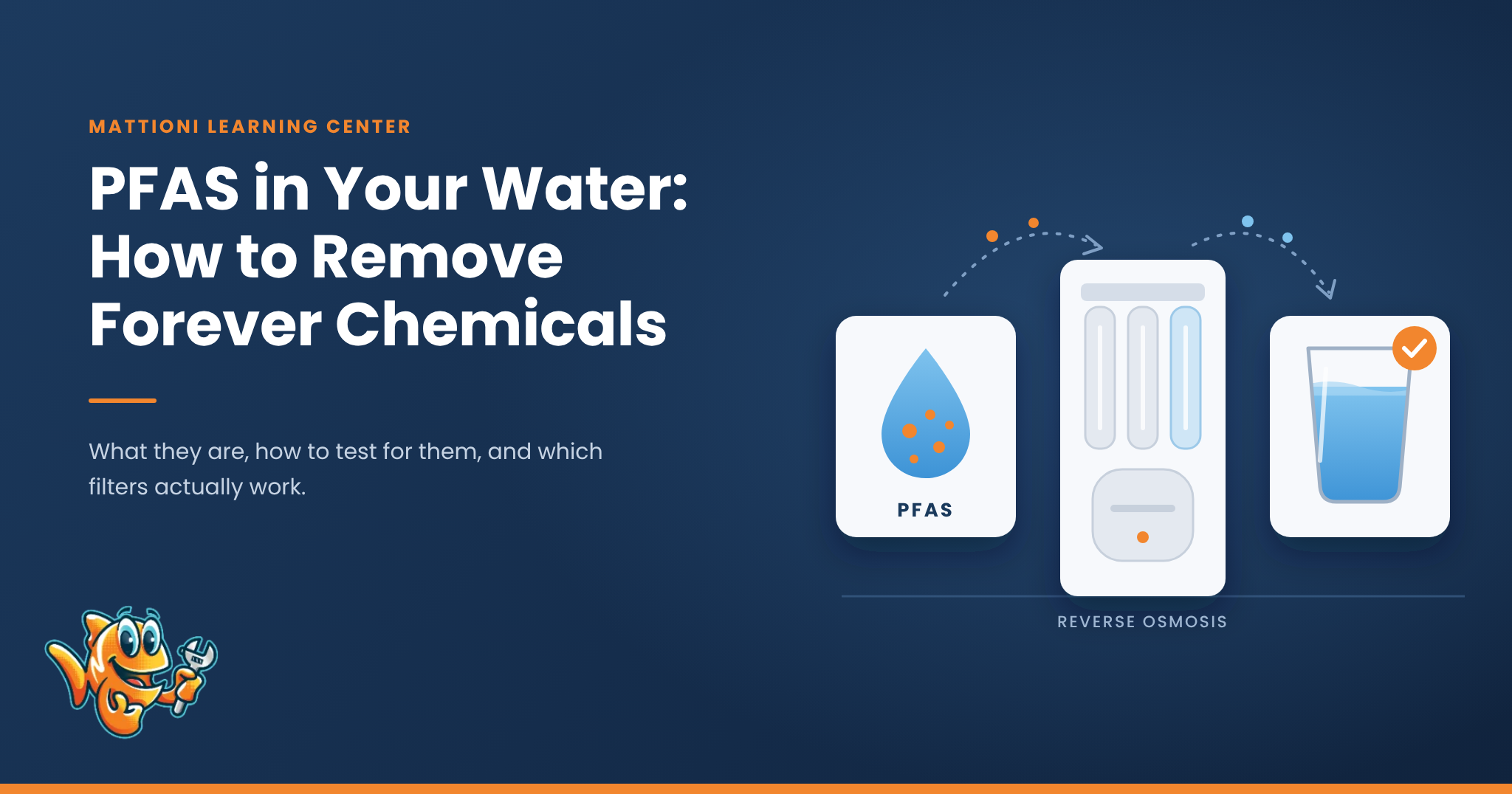
A reverse osmosis system pushes water through a membrane with pores small enough to block PFAS molecules. It also filters out lead, arsenic, nitrates, and fluoride. It’s installed under your kitchen sink and feeds a dedicated faucet, so the water you drink and cook with is covered.
How a reverse osmosis system removes PFAS
Blocked contaminants are flushed down the drain with a small amount of water.
RO does have trade-offs. It loses water as part of the process, it removes some beneficial minerals, and it needs some regular maintenance with filter replacements. For most families concerned about PFAS, those trade-offs may be well worth it. You can read more in our Water Filter Guide.
Carbon Filtration
Activated carbon traps PFAS on its surface. It works well on longer-chain PFAS like PFOA and PFOS, but it’s generally less effective on short-chain PFAS than reverse osmosis. Once a carbon filter is saturated, it stops reducing PFAS, so the carbon has to be replaced routinely.
Do you need a whole-home system for PFAS?
Usually not. Drinking and cooking are the main ways PFAS from water get into your body. That’s why a point-of-use system at the kitchen sink is the right first step for most homes. A whole-home carbon system makes sense if you want filtered water everywhere or you’re also tackling chlorine, taste, and odor, which is what our City Water Conditioning Package is designed for.
Why your water softener won’t help
We hear this one a lot. A water softener uses ion exchange to swap out calcium and magnesium. It’s great for protecting your pipes and appliances, but it does nothing for PFAS. If you already have a softener, an RO system pairs well with it, since softened water helps the RO membrane last longer, according to John Meiklejohn, one of Mattioni’s Water Conditioning Specialists.
How Much Does PFAS Filtration Cost?
At Mattioni, a professionally installed under-sink reverse osmosis system typically runs $2,000 to $3,000, depending on the system and your home’s plumbing. That price, and pricing for other filtration systems, are listed in our Water Conditioning Buyer’s Guide.
Take Control of PFAS in Your Home’s Water
You can’t see, smell, or taste PFAS, and you can’t depend on a utility timeline that could stretch for years. The good news? You don’t have to guess or go at it alone.
Here’s the plan:
1. Know your numbers. Check your utility’s water quality report, or get a lab test if you’re on a well.
2. Talk to a local expert. Call Mattioni at (610) 400-8510 or book online. We’ll review your results, look at your plumbing, and walk you through the options that fit your home and budget.
3. Drink with confidence. We’ll install a certified system and keep it maintained, so your family has clean, PFAS-reduced water every time they fill a glass.
We’ve been taking care of homes across Chester, Delaware, and Montgomery counties since 1948, and our neighbors’ water is personal to us. Instead of wondering what’s in every glass, you’ll know your family is protected.
Schedule a water quality consultation online, or call us now at (610) 400-8510.