
Quick answers: UV water systems
Only a positive well water test for coliform bacteria or E. coli tells you that for certain. Not taste, smell, or a recent storm.
No. It runs continuously; the value is having it installed before a storm, not adding one after.
Typically $4,200–$5,000 installed, depending on flow rate; about $200 a year to maintain.
Not recommended. The UV lamp is a fragile, mercury vapor bulb, and lamp/sleeve service is almost always left to a trained technician.
No. It disinfects bacteria, viruses, and protozoa, but doesn't remove hardness, chemicals, or dissolved solids.
You Can’t See, Taste, or Smell What Might Be in Your Water
Last Revised: 9/17/26
Picture your family’s morning: coffee brewing, the kids brushing their teeth, a glass of water straight from the tap. Everything looks completely normal, and that’s exactly why water safety is so easy to put off. You won’t taste bacteria. Usually the only clue something’s wrong shows up after someone’s already gotten sick.
If your home runs on well water, UV disinfection is one of those things you don’t think about until you have to: a positive test, a home sale, or a stomach bug that won’t go away. In this article, we’ll tell you what actually tells you it’s time to look into a system like this, and what changes once you have one.
Mattioni’s been serving well water homes across Chester County and Southeastern Pennsylvania for more than 75 years, and this is exactly what we walk homeowners through when they ask us this question. It all starts with what your specific water situation actually calls for.
"The UV disinfecting system is best for homes on well water because there usually isn't something there for treating bacteria. Public water is treated with chlorine, which kills bacteria. But well water homes are often defenseless against it."
- John Meiklejohn, Water Conditioning Specialist
Did You Know? Heavy Rain Doesn’t Make UV “More Effective”
Heavy rain and flooding do raise the risk of well contamination; surface runoff can carry bacteria into a shallow well, a cracked casing, or a compromised seal. But that’s a reason to test your water sooner, not a reason to think UV becomes more effective afterward (which is a common myth). A UV system runs continuously, treating every gallon rain or shine. The real lesson is that having UV already installed before a storm is what protects you during and after it, not adding one in response to a single event.
How Much Does a UV Water System Cost?
Pricing may depend on your home’s flow rate and whether you’re installing new or replacing an existing system:
| Service | Typical Price |
|---|---|
| Install 15 GPM UV system | $5,000 |
| Install 7 GPM UV system | $4,200 |
| Replace 15 GPM system | $2,100 |
| Replace 7 GPM system | $1,700 |
Once a system is installed, the ongoing cost is mostly just the annual bulb replacement, around $200 a year for parts.
The Real Signal Is a Water Test, Not Just Your Senses
Bacteria, viruses, and parasites like Cryptosporidium and Giardia don’t change how water looks, tastes, or smells. The only way to know if well water is contaminated is to test it, and not every test tells you the same thing.
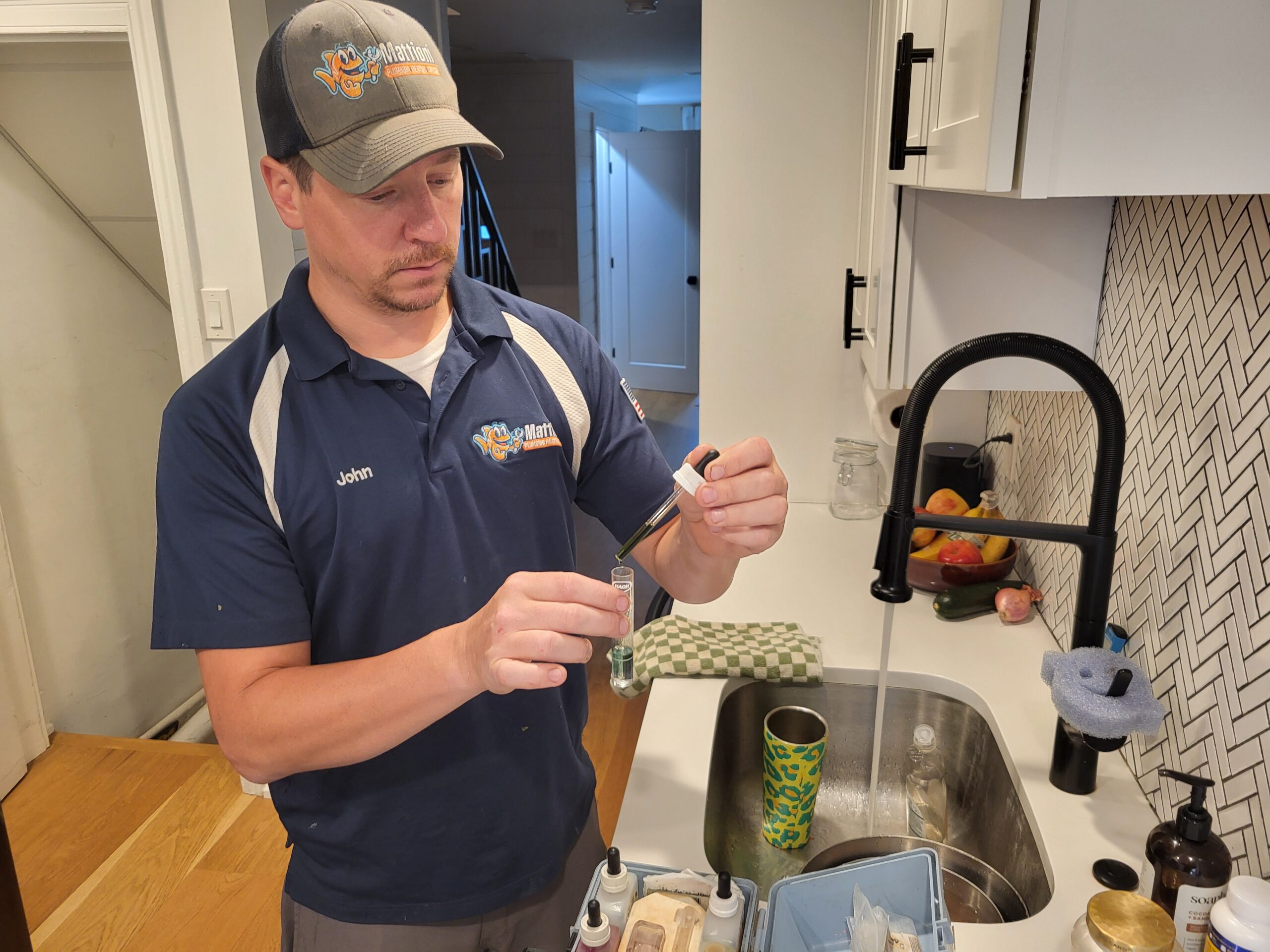
Basic drop or strip kits, the kind sold at hardware stores, check things like pH, hardness, chlorine, iron, and total dissolved solids (TDS). Mattioni’s own on-site water test covers those same parameters. Bacteria, viruses, and nitrates require a certified lab test, not a DIY kit or an on-site check. Your water can pass every taste-and-hardness test and still carry E. coli.
Public health agencies recommend testing well water at least once a year for bacteria (total coliform and E. coli) and nitrates. A positive result for coliform bacteria or E. coli is the clearest, most direct signal that a UV system is worth considering.
when is it Worth Asking About UV Water Systems?
Buying or selling a home. Many lenders and real estate transactions require a well water test at closing, and that’s often when contamination first turns up.
Unexplained illness. Recurring stomach or GI symptoms in the household, with no other clear cause, are worth checking against a water test.
Municipal water as a second barrier. Utilities already disinfect, but some households near aging infrastructure or in areas with occasional boil-water advisories add UV as supplemental protection. See Is West Chester PA’s Water Safe? for a look at local water quality.
An existing filtration or softening system. UV is usually the last step in a treatment train, since it doesn’t address hardness, chlorine taste, iron staining, or sediment on its own. See our whole-home filtration andwater softener options.
How UV Disinfection Actually Works
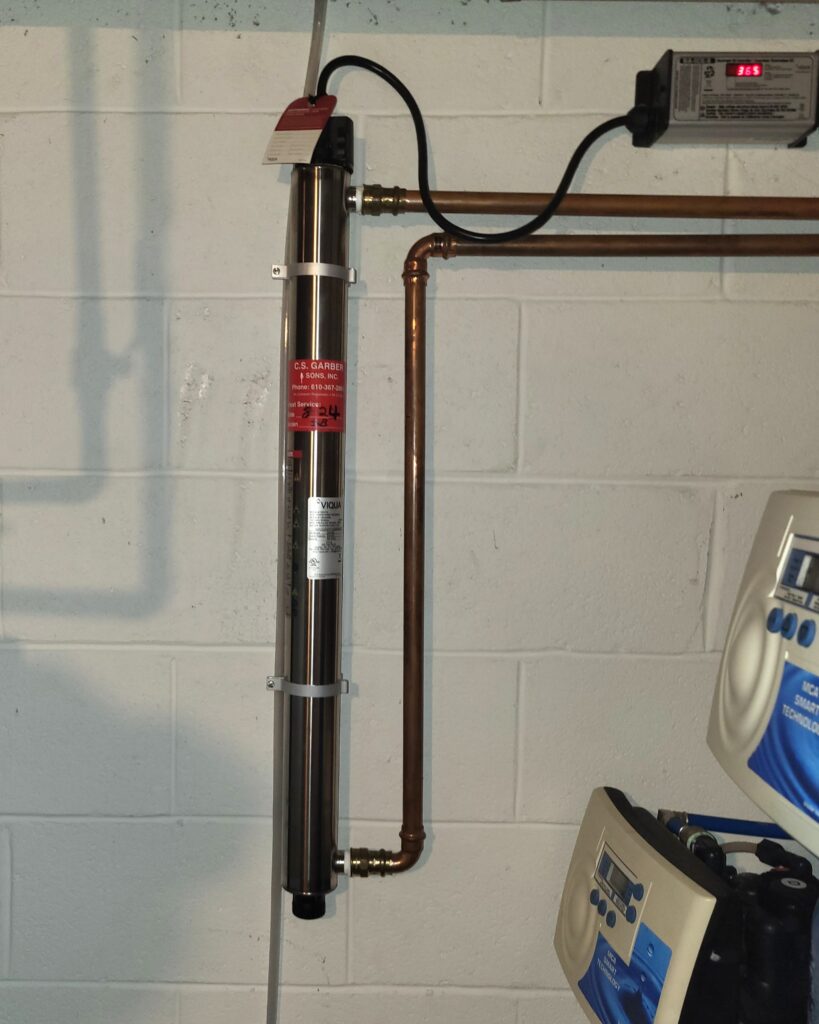
As water flows through a sealed chamber, it passes a UV-C lamp. The UV light disrupts the DNA of bacteria, viruses, and protozoa, so they can’t reproduce or cause illness.
The whole process happens in seconds, inside one sealed chamber, as water flows through the house.
It’s a physical process, not a chemical one. UV doesn’t add anything to the water and doesn’t change its taste or odor. It also doesn’t remove hardness, chemicals, or dissolved solids, which is why it’s usually paired with filtration or softening rather than used on its own.
UV systems built for well water carry NSF/ANSI 55 Class A certification, which validates them for primary disinfection of untreated water. That’s a higher bar than Class B systems, which only supplement water that’s already safe, like treated municipal supply. A Class A rating is what tells you a system is actually built to handle what’s coming out of your well, not just polish water that’s already been treated.
What Changes After Installation
The honest answer: not much you can feel day to day, and that’s the point. If your water already tasted fine, it will taste the same. What’s different is what’s no longer there: viable bacteria and parasites that could otherwise make someone sick.
Protection runs automatically, including during and after storms, without you having to think about it. The system does ask for a small yearly task: replacing the UV lamp (about once a year for residential systems), periodically wiping down the quartz sleeve, and responding if a sensor alarm signals the dose has dropped.
Maintenance Isn’t a DIY Job
A UV system needs a new lamp every year (every two years on commercial-grade models), plus occasional cleaning of the quartz sleeve that houses it. That sounds simple, but the lamp itself is genuinely fragile: it’s a sealed, mercury-vapor bulb inside a glass quartz sleeve, and it doesn’t take much to crack either one.
A cracked sleeve means water intrusion and a system that quietly stops disinfecting. A broken lamp means a mercury exposure risk and a system that needs to be recalibrated to keep its certification valid. That’s why lamp changes and sleeve service are almost always left to a trained technician rather than handled as a homeowner DIY project.
"Replacing the UV bulb has to be done every year, and it's not a DIY job unfortunately. Very few people are able to replace it themselves since the bulb is very fragile and must be connected in a very slim housing compartment about 3 feet long. It costs a couple hundred bucks, so a failed DIY attempt where the bulb breaks is a common and frustrating situation."
- John Meiklejohn, Water Conditioning Specialist
Frequently Asked Questions
Do I need a UV water system?
Only if a well water test comes back positive for coliform bacteria or E. coli. That’s the clearest, most direct signal, not how your water looks or tastes.
Does UV disinfection work better after heavy rain?
No. A UV system runs continuously and treats every gallon as it flows through, rain or shine. Having it installed before a storm is what protects you, not adding one afterward.
How much does a UV water system cost?
Installed systems typically run $4,200–$5,000 depending on flow rate (7 GPM vs. 15 GPM); replacing an existing system runs $1,700–$2,100, and an annual bulb runs about $130.
Can I test my own well water?
Basic drop or strip kits check pH, hardness, chlorine, iron, and TDS, but bacteria, viruses, and nitrates require a certified lab test. Your water can pass every taste-and-hardness check and still carry E. coli.
Can I replace the UV lamp myself?
It’s not recommended. The lamp is a sealed, mercury-vapor bulb inside a fragile quartz sleeve, and a crack or break can mean water intrusion, a mercury exposure risk, or a system that loses its certification. This is almost always left to a trained technician.
Does a UV system remove hardness or chlorine taste?
No. UV only disinfects biological contaminants; it doesn’t address hardness, chemicals, or dissolved solids, which is why it’s usually paired with filtration or softening.
What's the difference between NSF/ANSI 55 Class A and Class B systems?
Class A systems are certified for primary disinfection of untreated water, like a private well. Class B systems only supplement water that’s already safe, such as treated municipal supply.
The Big Takeaway on Well Water Bacteria
Test your well water at least once a year, and sooner after flooding, a nearby septic issue, or any change to the well itself. A positive bacteria result, not a hunch about the weather, is the real signal to talk to a water treatment Pro about installing a UV system.
Book your appointment with Mattioni online now or call our friendly team of experts at (610) 400-8510