
Quick answers: heat pump ice & defrost mode
Is ice on my heat pump normal?
A thin, even layer of white frost on the outdoor coil is normal in cold, damp weather, and your heat pump clears it automatically with a defrost cycle. Thick ice that covers the coil, the top of the unit or the refrigerant lines and doesn't clear is not normal and needs a technician.
What is heat pump defrost mode?
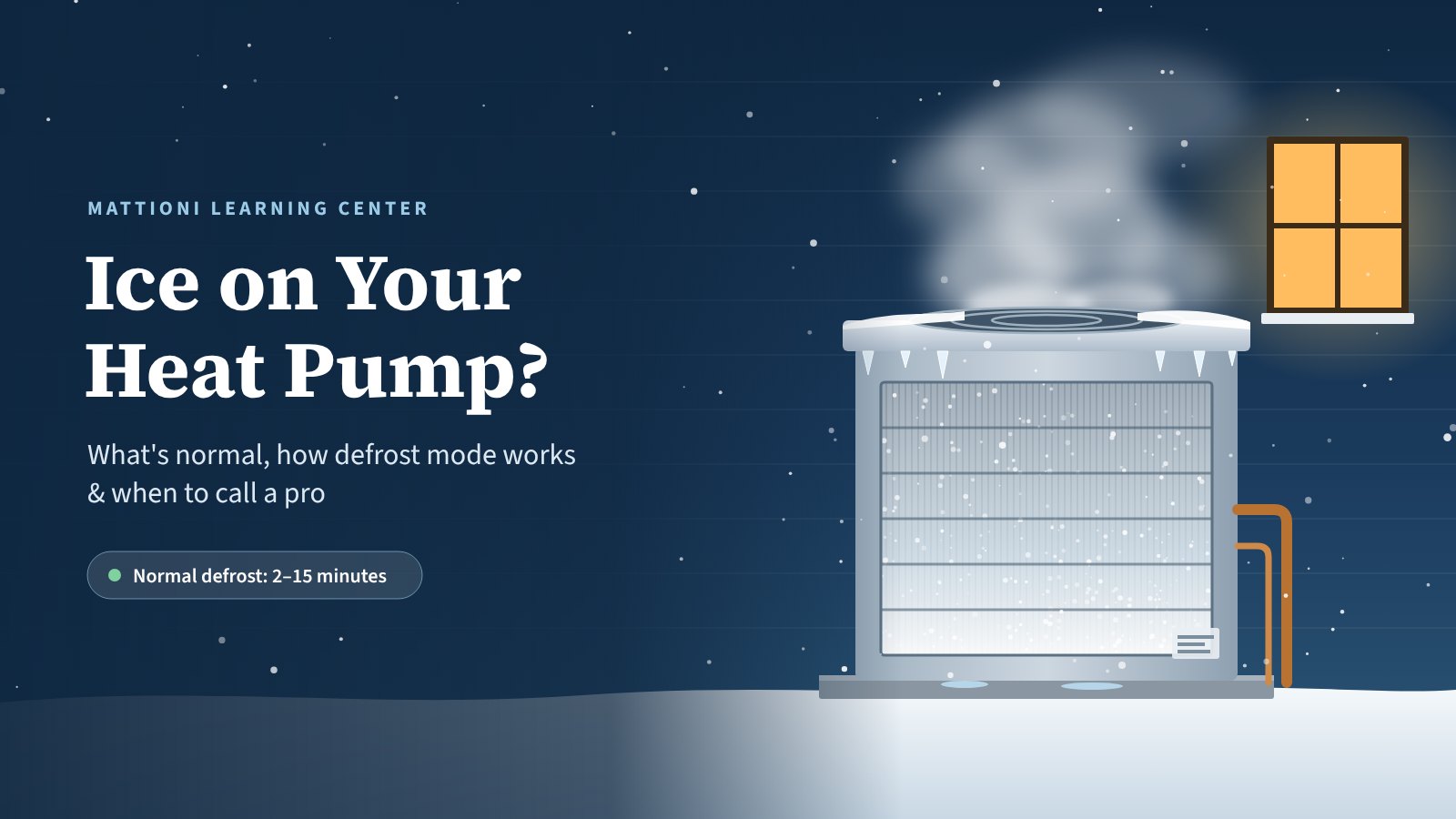
Defrost mode is your heat pump's automatic way of melting frost off the outdoor coil. A reversing valve briefly switches the system into cooling mode, which sends hot refrigerant to the outdoor coil. The outdoor fan stops, steam may rise, and backup heat keeps your home warm until normal heating resumes.
How long does a heat pump defrost cycle last?
Most defrost cycles take 2–15 minutes. In damp weather around 32°F, it's normal for them to repeat every 30–90 minutes. Cycles that repeat every 10–15 minutes for hours point to a problem.
Why is steam coming out of my heat pump?
The white cloud is water vapor from frost melting during a defrost cycle. It has no smell and fades within a few minutes. Dark smoke, a burning smell or vapor that won't stop is not normal.
When should I call a pro about an iced-up heat pump?
Call a technician if the unit is still iced over after two to three hours, if the ice comes back within a day, or if your home is getting colder. Mattioni provides same-day heat pump service across Chester, Delaware and Montgomery counties in Southeastern Pennsylvania.
Last Revised: 10/30/26
It’s 34°F outside, the air is damp, and you look out the window to find your heat pump coated in white frost. Or worse, there’s a cloud of what looks like smoke coming out of it. Many people would assume something is wrong, but most of the time it’s a normal heat pump function called defrost mode.
Heat pumps extract heat from ambient outdoor air, so it’s not unusual to see some frost build up on the outdoor unit in the winter. That “smoke” you see is almost always normal; it’s steam that the system’s defrost cycle intentionally produces to clear the unit of frost.
However, some ice really is a warning sign of some deeper issues with your heat pump, and knowing the difference can save you an unnecessary service call.
That’s what this article is about. You’ll learn why heat pumps frost up, what defrost mode does, how to tell normal frost from a real problem, what you can safely do yourself, and when it’s time to call a pro.
If you’re new to heat pumps, our article on heat pumps vs. air conditioners is a helpful starting point.
What’s Ahead
- Why do heat pumps build up ice in winter?
- What is heat pump defrost mode, and how does it work?
- How long does a heat pump defrost cycle last?
- What to do if your heat pump is covered in ice
- How to prevent heat pump icing problems
Why do heat pumps build up ice in winter?
In heating mode, your heat pump pulls heat out of the outdoor air and moves it inside. To do that, the outdoor coil has to run colder than the air around it, even on a cold day.
When the coil drops below freezing and the air carries moisture, that moisture freezes onto the coil’s fins in the same way frost forms on your car windshield overnight. A little frost is harmless. But as it builds up, it blocks airflow and forms a barrier around the coil, so the heat pump can’t pull heat from the air as well. That’s why every heat pump has a built-in way to clear it.
Here’s what surprises a lot of homeowners: heat pumps usually run into frost problems more often on damp days right around 32°F than on the coldest, driest days of winter. Bitterly cold air holds little moisture, so there’s less water to freeze. Southeastern PA’s typical winter weather of drizzle, fog, wet snow, and temperatures hovering around 30 to 40 degrees is where frost happens the most.
What is heat pump defrost mode, and how does it work?
Defrost mode is your heat pump’s automatic way of melting frost off the outdoor coil. Here’s the sequence, step by step:
- The control board decides the unit needs to be defrosted. A sensor on the outdoor coil watches its temperature, and once the coil is cold enough to frost (typically around 30°F or below), the system initiates a defrost.
- The system reverses its heat flow. The heat pump temporarily switches into cooling mode for a few minutes using a reversing valve. That sends hot refrigerant to the outdoor coil instead of the indoor one.
- The outdoor fan stops. With the fan off, heat stays in the coil and melts the frost. Water drips out of the bottom and you’ll often see steam rising.
- Backup heat temporarily kicks on to keep your home warm during the defrost cycle.
- Normal heating resumes. When the coil warms past a set temperature, the valve switches back and the fan restarts to continue heating your home.
How long does a heat pump defrost cycle last?
Most cycles take 2-15 minutes to complete. In damp weather right around 32 degrees, it’s normal for cycles to repeat about every 30-90 minutes. Your exact timing depends on your model, how it was set up, and the weather.
What you’ll see and hear during defrost
- Steam rising from the outdoor unit. This is water vapor from melting frost. It has no smell and fades within a few minutes.
- The outdoor fan stops while the compressor keeps running.
- A whoosh or hiss when the reversing valve switches at the start and end of the cycle.
- Water dripping or pooling under the unit.
- Slightly cooler air or “AUX” on your thermostat for a few minutes while backup heat runs.
Is ice on my heat pump normal?
Use this side-by-side check the next time you see frost or ice on your outdoor unit.
| What you notice | Normal | Call a pro |
|---|---|---|
| Frost on the coil | Thin, even white frost you can still see the fins through | Solid, clear ice covering the coil so you can't see the fins |
| After a defrost cycle | Frost clears and the coil looks wet | Ice is still there after 2–3 hours |
| Defrost timing | 2–15 minutes, repeating every 30–90 minutes in damp weather | Cycles every 10–15 minutes for hours, or never seems to defrost at all |
| Steam | White, odorless, stops within minutes | Dark smoke, a burning smell, or vapor that won't stop |
| Where the ice is | On the coil fins only | On the top cover, fan blades, or the copper refrigerant lines |
| Indoor comfort | Brief cooler air, then warm air returns | Home keeps getting colder, or the thermostat stays on AUX/EM heat |
| Fan | Pauses during defrost, then restarts | Grinding, hitting ice, or not spinning during normal heating |
What causes a heat pump to freeze up?
When ice keeps coming back or won’t clear, one of these is usually behind it:
- A failed defrost sensor or control board. If the board never starts a defrost, frost will eventually turn into a block of ice.
- A stuck reversing valve. If the valve can’t switch to cooling mode, the system can’t send heat to the outdoor coil.
- Low refrigerant. A leak makes the coil run colder than designed, so it frosts faster and heats poorly. Learn more about refrigerant charge and why refrigerant repairs cost what they do.
- An outdoor fan motor or capacitor problem. Without airflow during heating, the coil frosts quickly.
- Dirty coils or poor indoor airflow. A clogged filter or dirty coil makes the whole system work harder.
- Water dripping on the unit. A leaking or overflowing gutter above a heat pump can coat the top and fan in ice. Defrost can’t fix this.
- Poor drainage or snow buildup. If melt water can’t drain away, it refreezes around the base. Units should sit level and raised off the ground. See what to do if your outdoor unit isn’t level.
What to do if your heat pump is covered in ice
If your unit is iced over and you want to help it before calling a pro, these steps are safe to follow:
- Give it one full defrost cycle. Wait 60 to 90 minutes and see whether a defrost cycle clears the coil. Many “frozen” units will fix themselves.
- Clear snow and debris. Keep at least 18 to 24 inches clear around the unit and make sure the top isn’t buried. Our guide to heat pump care after snow covers this in more detail.
- Look up. Check whether a gutter or downspout is dripping onto the unit.
- Check the thermostat. Make sure it’s set to HEAT, not stuck on Emergency Heat, and replace the air filter if it’s dirty.
- Melt ice gently, if needed. Turn the system off at the thermostat and pour lukewarm (not boiling) water over the ice. Never chip or pry at the ice. The coil’s aluminum fins and copper tubing puncture easily, and a refrigerant leak is a far bigger repair than a frozen coil.
- Call if it comes back. If the ice returns within a day, something is stopping defrost from working. That needs a technician.
What not to do: don’t cover the unit while it’s running, don’t hit the fan grille to knock ice off, and don’t open the electrical panel. If you’re wondering about winter covers in general, read whether you should cover your outdoor unit in winter.
Emergency heat vs. auxiliary heat: what’s the difference?
Your thermostat may show two different backup heat settings, and they mean different things:
- Auxiliary heat (AUX) turns on automatically when the heat pump needs help, such as during defrost or on very cold days. Seeing “AUX” for a few minutes during defrost is normal.
- Emergency heat (EM or E-heat) is something you turn on. It shuts the heat pump off completely and runs only your backup heat. Use it only if the heat pump has stopped working and you’re waiting for a repair.
Backup heat is usually electric resistance heat, which costs much more to run than the heat pump itself. The Department of Energy notes that energy codes require controls to keep heat strips from running unnecessarily, and that this is one of the most commonly violated heat pump installation practices. If your heat pump spends a lot of time on backup heat, your electric bill will show it. Read more in What Is a Backup Heat Source? and Why Is My Energy Bill So High in Winter?
How to Prevent Heat Pump Icing Problems
- Schedule fall maintenance. A technician checks the defrost board, sensor, reversing valve, refrigerant charge, and fan before the cold arrives.
- Keep the area around the unit clear of leaves, snow, mulch and shrubs.
- Fix gutters and downspouts that drain near the unit.
- Change your air filter regularly so indoor airflow stays strong.
- Make sure the unit sits level and raised so melt water drains away.
Get Your Heat Pump Ready for Winter with Mattioni
A frosty heat pump is usually just a heat pump doing its job. But when ice won’t clear, your home is getting colder, or your electric bill is climbing, you deserve a straight answer from someone who’ll explain what’s going on in plain terms. Mattioni has been doing that since 1948.
Here’s how to get there:
- Check what you’re seeing against the table and flowchart above.
- Call Mattioni at (610) 400-8510 or schedule heat pump service for same-day service across Chester, Delaware, and Montgomery counties.
- Stay warm with confidence. Our certified technicians find the root cause of the problem, give you upfront pricing before any work begins, and leave your system ready for the rest of winter.
Want to stop worrying about it every winter? A Mattioni VIP Membership includes two HVAC tune-ups a year, priority service and repair discounts, and we’ll call you when it’s time to schedule.
Instead of jumping every time your heat pump runs its defrost cycle, you’ll know exactly what’s normal, and you’ll have a team you can trust on call when it isn’t.