

Quick answers: no water from the faucet
Why is no water coming out of my faucet?
If one faucet is dry, the cause is almost always local to that fixture. A closed shutoff valve under the sink, a clogged aerator, or a failed cartridge. If every faucet in the house is dry, the cause is upstream: a closed main shutoff valve, a frozen pipe, a well pump or pressure tank failure, a broken water main, or a utility shutoff.
What should I check first?
Count how many fixtures are affected. That single question splits the problem in half and tells you whether you're looking under one sink or at your whole water supply. Then check whether it's only the hot side.
Can I fix no water coming out of the faucet myself?
Sometimes. Reopening a shutoff valve, cleaning an aerator, or waiting out a posted utility shutoff are all homeowner-friendly. Anything involving a frozen pipe you can't reach, a well pump, a water heater, or a suspected main line break needs a licensed plumber.
Is no water from the faucet an emergency?
It becomes one the moment you see water where it doesn't belong, smell gas near a water heater, or lose water during a hard freeze. Any of those three means shut off your main valve and call a plumber right away.
How fast can a plumber restore my water?
Most no-water calls in Chester, Delaware, Montgomery, Berks, and Lancaster counties are diagnosed and resolved in a single visit. Mattioni offers same-day and 24/7 emergency plumbing service at (610) 400-8510.
Last Revised: 7/24/26
You turned the handle and nothing happened. When your faucet goes silent it’s a real moment that can halt your household. No coffee, no shower, no clean dishes; and a newfound worry about what it’s going to cost.
Here’s the reassuring part: most of the no-water calls we receive trace back to a handful of causes, and you may be able to diagnose it yourself in 10 minutes or less. The trick is knowing what to check first, because the solution could be simple or require professional assistance.
This article walks you through that order the same way one of our plumbing technicians would if they were inspecting your home. Work through these steps top to bottom, and by the end you’ll either have your water back or you’ll know exactly what to tell your plumber.
Stop and read this first
If you have lost water and you see any of the following, don't troubleshoot. Shut off your main water valve and call for emergency service immediately:
- Water pooling, dripping, or staining a ceiling, wall, or floor
- A soggy, sunken, or unusually green patch in the yard near the street
- The sound of running water when every fixture is off
- A gas smell near your water heater
Not sure where your main valve is? Here's how to shut off your main water line valve. It's worth reading before you need it.
Why Is No Water Coming Out of My Faucet?
Every cause of a dry faucet lives somewhere along the path water takes to reach it. From the street or your well, through your main valve and plumbing branches, and out the fixture. Finding the break in that chain is the job at hand.
Start with the fastest test: walk your house and turn on every faucet, including the tub and an outdoor spigot. What you find puts you in one of four situations.
| What you found | Most likely cause | Your next move | Who fixes it |
|---|---|---|---|
| One faucet only | Closed shutoff valve under the sink, clogged aerator, failed cartridge or stem | Check under the sink, then unscrew the aerator | Often DIY |
| Only the hot side | Water heater shutoff closed, heater failure, or a blockage at the heater outlet | Check the valve on top of the water heater | Usually a pro |
| One room or one floor | Frozen branch line, isolated shutoff, or a failed section of pipe | Check the temperature of that space and any nearby valves | Usually a pro |
| The entire house | Main valve closed, frozen main, well pump or pressure tank failure, water main break, utility shutoff | Check your main valve, then text a neighbor | Call a plumber |
Swipe to see more →
Follow the Water: Six Checkpoints Between the Street and Your Sink
Water reaches your faucet through a fixed sequence of components. A technician doesn’t just guess, they’ll walk that sequence backward from the dry faucet until they find the issue. Here’s that path:
The water supply path
Street main or well
Utility break, planned shutoff, or a well pump that isn't running
Service line
The buried pipe to your house. May face cracks, corrosion, or root intrusion
Main shutoff valve
Left closed after a repair, or seized from age and never fully reopened
Water heater
Affects the hot side only. Could be a useful clue, not a coincidence
Branch lines
Where freezes happen: crawl spaces, exterior walls, unheated garages
The fixture
Angle stops under the sink, the aerator, and the cartridge inside the handle
Is It Only the Hot Water?
This is the check most homeowners skip, but verifying if it’s just hot water can save a lot of time. Run the cold side alone, then the hot side alone, at two different fixtures. The patter can help diagnose what’s happening:
| Cold side | Hot side | What it means |
|---|---|---|
| Flowing | Nothing | The problem is at or after your water heater. Your supply is fine. |
| Nothing | Flowing | Unusual. Points to a closed cold-inlet valve or a frozen cold branch. |
| Nothing | Nothing (one fixture) | That fixture's cartridge, or both angle stops closed under the sink. |
| Nothing | Nothing (whole house) | Supply-side. Main valve, frozen main, well system, or utility issue. |
Swipe to see more →
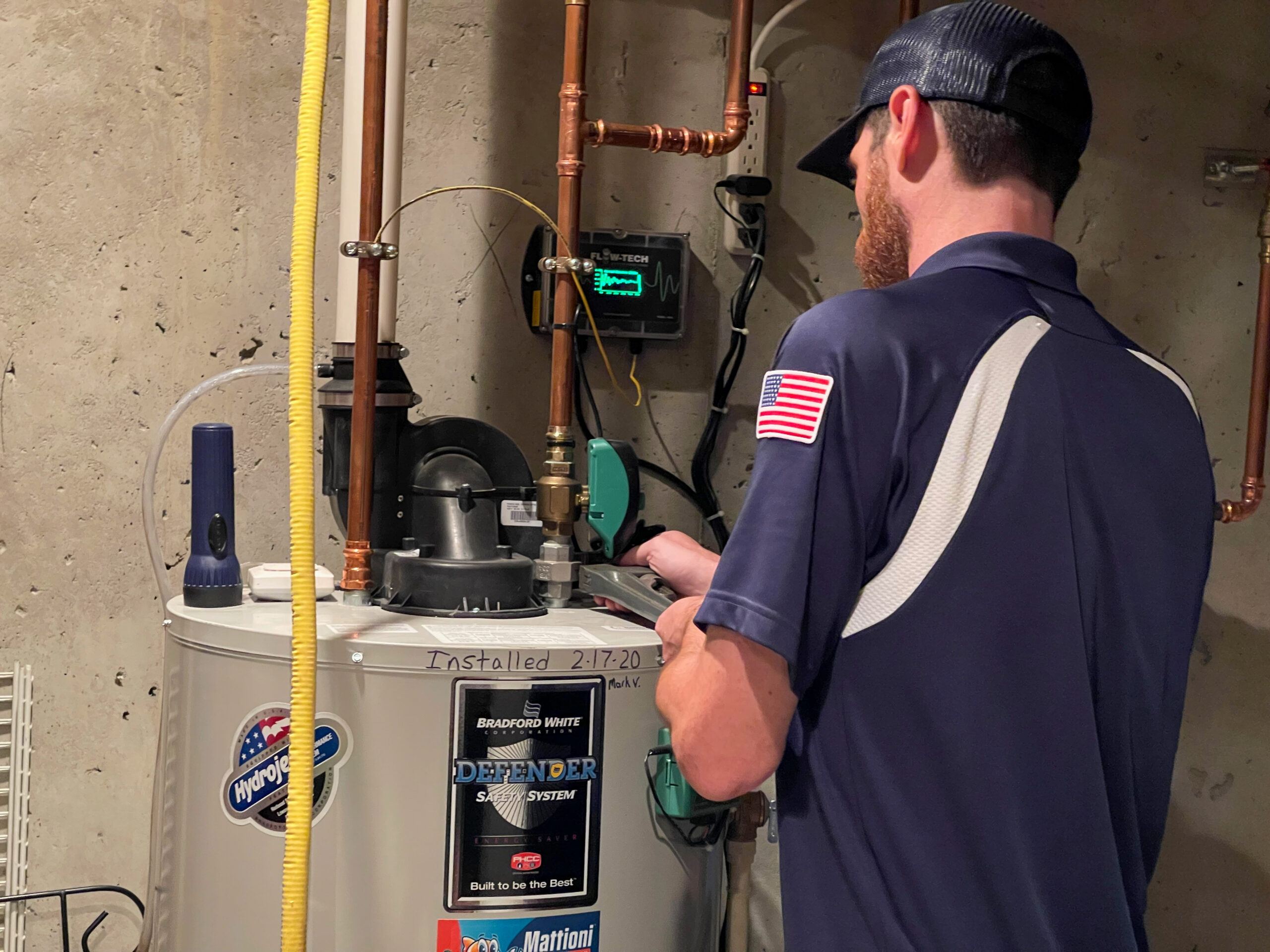
If you’ve landed on a water heater problem, that’s a separate diagnostic path, and it’s rarely a DIY repair. Our team handles water heater repair and replacement across the region.
How to Check Your Main Water Shutoff Valve
A surprising number of no-water calls we get end with this simple fix. A valve gets closed for a repair, a remodel, or a winterization, and it never fully gets reopened. Or, it looks open but the internal gate has failed. Here’s the five-minute test:
Four steps, about five minutes
- Find the valve. In most Pennsylvania homes it's in the basement or crawl space on the wall facing the street, usually within a few feet of the water meter. In a slab home, check a utility closet or the garage.
- Read its position. A lever-style ball valve is open when the handle runs parallel to the pipe, closed when it's perpendicular. A round wheel-style gate valve needs to be turned fully counterclockwise to open.
- Open it slowly. If it's closed or partly closed, open it gradually. Snapping it open sends a pressure surge through the house that can pop a weak joint or a supply hose.
- Bleed the air. Open the highest and lowest faucets in the house and let them run until the sputtering stops and the stream is steady.
If the valve is already fully open and you still have nothing, the problem is upstream in the service line or the supply itself. That’s where a failing main water line starts to look like the culprit, especially in older homes with galvanized steel service lines.
Could Your Pipes Be Frozen?
From December through February in southeastern Pennsylvania, frozen pipes jump to the top of the list. Particularly if the water stopped overnight, it’s the coldest morning of the week, and the affected fixture sits on an exterior wall. A frozen pipe can cut flow to a trickle or to nothing at all.
Risk isn’t linear with temperature. It concentrates at specific thresholds:
Freeze risk for uninsulated pipes in unheated space
Above 32°F
Minimal
Standing water won't freeze. Look elsewhere.
20–32°F
Elevated
Exposed and uninsulated runs start to be vulnerable.
Below 20°F
High
The widely used alert threshold for unprotected pipes.
Sustained
Severe
Multiple days below 20°F reach pipes inside walls and buried lines.
Wind exposure matters as much as the reading on the thermometer. A pipe in a drafty crawl space freezes well before an identical pipe in a still basement.
If you suspect a freeze: leave the affected faucet open so melting ice has somewhere to go and pressure can’t build behind the blockage. First, open the cabinet doors under sinks on exterior walls to let your household heat reach the supply lines. If you can safely reach the frozen section, try warming it gradually with a hair dryer or a space heater aimed at the area, working from the faucet end back toward the frozen spot.
Pro Tip: A frozen pipe is also a burst pipe waiting to happen. The ice expands and the damage often shows up during the thaw, not the freeze. If you’re unsure, read how to tell if your pipes are frozen and what to do when a pipe bursts. To keep it from happening again next winter, our winter plumbing prep checklist covers the insulation and shutoff work that prevents most frozen pipes.
On a Private Well? Your Troubleshooting Is Different
Plenty of homes across Chester County, Montgomery County, and Delaware County run on private wells rather than municipal water. If that’s you, several of the checks above don’t apply, and a few important ones get added:
| Check | Municipal water | Private well |
|---|---|---|
| Ask the neighbors | Very useful; a shared outage points straight to the utility | Not useful. Your well serves your house alone. |
| Electrical panel | Rarely relevant | Check first. A tripped well pump breaker is a common and easy find. |
| Pressure tank | Not present | Check the gauge. A reading at or near zero means the pump isn't delivering. |
| Listen at the tank | Not applicable | A pump that clicks, hums, or runs without building pressure needs service. |
| Recent drought | No effect on supply | A dropping water table can leave the pump drawing air. |
Swipe to see more →
Well components fail gradually before they fail completely, so a total loss of water often follows weeks of sputtering taps or pressure that surges and drops. If yours has been doing that, our guide to well pump replacement costs will help you plan.
What the Sounds and Symptoms Are Telling You
Your plumbing gives away a lot before it goes quiet. If you noticed any of these in the days or hours before the water stopped, mention them when you call. They can cut diagnostic time in half.
| What you noticed | What it usually points to |
|---|---|
| Spitting, sputtering, air in the line | Air entering the system; a well pump losing prime, or a supply that was recently interrupted |
| Banging or knocking in the walls | Pressure surges, loose pipe strapping, or ice shifting inside a frozen line |
| Rust-colored, cloudy, or flaking water | Pipe corrosion, common in galvanized steel lines in homes built before the 1970s |
| Pressure fading over weeks | A narrowing service line, a partial blockage, or a well system nearing the end of its life |
| A wet or unusually green strip in the yard | An underground service line leak. Call before it undermines the walk or the foundation |
| Water running when nothing is on | An active hidden leak somewhere in the system |
Swipe to see more →
The last two are worth acting on quickly. Mattioni’s leak detection products and services pinpoint hidden leaks without tearing up your yard or your drywall to find it.
When to Stop Troubleshooting and Call a Plumber
There’s real value in checking the easy things first (and real cost in pushing past the point where a repair requires specialized tools, licensing, and experience). Here’s the line to follow:
Reasonable to try yourself
- Opening a shutoff valve under a sink
- Unscrewing and rinsing a clogged aerator
- Resetting a tripped well pump breaker (once)
- Opening cabinet doors to warm a frozen supply line
- Calling the utility or asking a neighbor about an outage
- Bleeding air from the lines after service is restored
Call a licensed plumber
- Every fixture in the house is dry
- You suspect a frozen pipe you can't see or reach
- The well pump breaker trips again after a reset
- Water is appearing anywhere it shouldn't be
- The main valve is open and there's still no flow
- Anything involving the water heater or a gas connection
- Water returned, but it's discolored or the pressure is wrong
Get Your Water Back Today with Same-Day Service
Losing water isn’t just inconvenient. It stops a household, and it usually happens on the morning you have the least time to deal with it. For more than 75 years, Mattioni has been the team southeastern Pennsylvania homeowners call.
Here's how we get it fixed
Tell us what you found
Call, and walk us through what's dry and what still works.
We diagnose it on site
A licensed technician traces the supply path and finds the break.
Your water comes back on
Repaired, tested, and explained — usually in the same visit.
Call (610) 400-8510 or schedule online; 24/7 emergency service available.
By tonight, this can be a story about the morning the water stopped, and not an ongoing problem you're still working around. Turn the handle, hear it run, and get your house back.
Planning a larger repair? Check our current deals and financing options, or look at emergency plumbing services to see what same-day service covers.